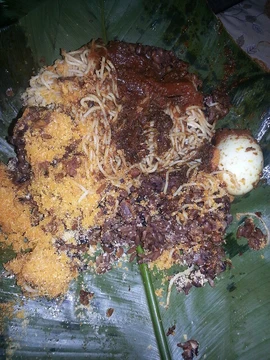
Fura (food)
A millet dough ball from the Sahel, often served with fermented milk.
Fura, also called doonu, comes from the Sahel region of West Africa and is a staple among the Zarma-Songhai, Fulani, and Hausa communities. The word "fura" itself means millet ball, and the food is a dough made from that grain. It is also commonly eaten in Niger and Ghana. To make the popular drink Fura Da Nono, the millet balls are mashed and mixed with nono, a fermented milk. This beverage provides both carbohydrates and fiber.
To prepare fura, millet or Guinea corn is first washed and peeled, then dried and ground into a powder along with dried ginger, cloves, and chili pepper. Salt is added, and the mixture is placed in a mortar and pounded while water is gradually sprinkled in to form a dough. This dough is then shaped into balls. Alternatively, the dough can be left in a bowl covered with a leaf overnight to ferment. The balls are cooked, pounded again with more water until very soft, and then reshaped. Finally, they are dusted with millet or corn flour to keep them from sticking.
In Nigeria, what was once a simple local meal called Fura da Nono has grown into a commercial enterprise, with modern processing methods now used in its production.
- origin
- West Africa's Sahel region
- associated_peoples
- Zarma-Songhai, Fulani, Hausa
- also_eaten_in
- Niger, Ghana
- popular_in
- Northern Nigeria
- main_ingredient
- Millet
- related_drink
- Fura Da Nono
Lore & Background
Fura is prepared by washing millet and removing the peels, then drying and grinding it along with dried ginger, cloves, and chili pepper into a powdered form. Salt is added, and the mixture is poured into a mortar and pounded while water is sprinkled gradually to form a dough. The dough is molded into ball shapes, or it can be poured into a bowl and covered with a leaf overnight to ferment. The balls are cooked in a pot, then pounded again with water until very soft, shaped into balls, and dusted with millet or corn flour to prevent sticking.
Reader's Guide
Fura holds cultural and dietary significance in the Sahel region, particularly among the Zarma-Songhai, Fulani, and Hausa peoples. It is served on special occasions and as an afternoon meal. In Nigeria, Fura da Nono has evolved from a local meal into a growing enterprise involving modernized processing methods and production. The dish provides carbohydrate and fiber, and its preparation reflects traditional food processing techniques such as fermentation and pounding. Its popularity in Northern Nigeria and neighboring countries underscores its role as a staple street food and a symbol of regional culinary heritage.
Did You Know?
- Fura means 'millet ball' in the local language.
- Fura da Nono is a drink made from fura and fermented milk called nono.
- The millet is ground with dried ginger, cloves, and chili pepper.
- Fura is also eaten in Niger and Ghana.
Cultural Roots Across the Sahel
Fura, also known as doonu, is a traditional food whose name literally translates to "millet ball," a straightforward descriptor that has carried the dish across generations of West African communities. Its origins trace to the Sahel region, where it became a staple for the Zarma-Songhai, Fulani, and Hausa peoples. Beyond its heartland, the dish has found a place on tables in Niger and Ghana, testifying to its appeal across linguistic and ethnic boundaries. In Northern Nigeria, fura holds a particularly prominent position in the local food culture, where it is not merely a snack but a recognized meal. The name itself, rooted in the humble grain of millet, reflects the agricultural foundation of Sahel life, where millet cultivation has sustained communities for centuries. The fact that multiple distinct ethnic groups claim fura as their own speaks to its deep integration into the daily rhythms and shared culinary heritage of the region.
The Craft of Making Fura
The preparation of fura is a multi-stage process that demands patience and physical effort. It begins with washing raw millet to strip away its outer peels, followed by thorough drying. The dried grain is then ground into a fine powder alongside dried ginger, cloves, and chili pepper, creating a fragrant spice blend. Salt is stirred into the mixture before everything is transferred to a mortar, where it is pounded while water is gradually sprinkled in to coax the powder into a cohesive dough. The dough is then shaped by hand into the characteristic round balls that give the dish its name. An alternative path allows the dough to rest in a bowl, covered with a leaf overnight, so that natural fermentation develops additional depth of flavor. The balls are subsequently cooked in a pot, returned to the pounding stage, and worked with more water until the paste achieves an exceptionally soft consistency. Finally, the finished fura is shaped once more and dusted with a light coating of millet or corn flour so the individual balls do not cling together.
Fura Da Nono: A Meal and a Moment
When fura meets nono, a locally produced fermented milk, the result is Fura Da Nono, a pairing that transforms a simple grain ball into a complete, nourishing experience. The combination delivers both carbohydrate and fiber, making it a satisfying option rather than a mere treat. In Northern Nigeria, this pairing occupies a special place in the social calendar: it is prepared for special occasions and enjoyed as a dedicated afternoon meal, a ritual that anchors the midday-to-evening transition. The act of eating fura da nono is communal and unhurried, a time when the soft, pounded dough is worked together with the tangy, cultured milk. The name itself encodes the two essential components, leaving no ambiguity about what is on the table. For the Zarma-Songhai, Fulani, and Hausa communities of the Sahel, this meal is not an exotic delicacy but a familiar, grounding part of daily and celebratory life, a food that carries the taste of home and the comfort of tradition in equal measure.
From Hearth to Enterprise
What was once exclusively a home-cooked meal or a dish reserved for gatherings has undergone a notable transformation in Nigeria. Fura da Nono, long regarded as a local, informal food, has gradually grown from a household staple into a recognized business venture, incorporating modernized processing and production methods. This shift reflects broader economic changes in the region, where traditional foods are finding new markets and new audiences while retaining their essential character. The ingredients remain the same: millet or Guinea corn, the familiar spice blend of ginger, cloves, and chili, and the fermented milk. Yet the scale and method of preparation have expanded well beyond the domestic kitchen. This evolution does not erase the cultural weight of fura; rather, it signals that a dish rooted in Sahel tradition has proven its staying power, adapting to contemporary demand while preserving the flavors and techniques that made it beloved in the first place.
Gallery



Frequently Asked Questions
What is Fura (food)?
Fura is a millet dough ball that functions as a daily staple across West Africa's Sahel region. It goes by the alternate name doonu and is most closely tied to the Zarma-Songhai, Fulani, and Hausa communities.
Where does Fura come from and where is it eaten today?
Fura originated in the Sahel belt of West Africa and remains a common food in Niger, Ghana, and Northern Nigeria. Its deep roots in those areas make it a shared cultural dish rather than belonging to a single country.
What is Fura Da Nono and how is it made?
Fura Da Nono is a well-known drink created by mashing millet balls and stirring them into nono, a fermented milk. The resulting beverage supplies both carbohydrates and dietary fiber in one serving.
What ingredients and steps go into preparing Fura?
Millet or Guinea corn is washed, peeled, dried, and ground into a powder together with dried ginger, cloves, and chili pepper. Salt is then added to the spice mix before the mixture is shaped into dough balls.
Why is Fura culturally important to its communities?
The word fura literally means 'millet ball,' underscoring its identity as a grain-based energy source that has sustained Sahel peoples for generations. Its role as an affordable, filling staple makes it central to the daily food routines of Zarma-Songhai, Fulani, and Hausa families.
More in Ghanaian cuisine 1-20
Spotted an error? Know more?
This is a living reference — every entry is fact-audited, and reader corrections feed straight into our audit queue. Suggest an edit · See this site's audit record